
How Fast Does Mold Grow After a Flood?
The short answer comes from the U.S. Environmental Protection Agency: if wet or damp materials are dried within 24 to 48 hours after a leak or spill, in most cases mold will not grow. After a disaster, the EPA's guidance goes a step further: if you were not able to dry your flooded home within 24 to 48 hours, assume you have mold growth. The CDC gives the same advice.
For many Pagosa Springs and Archuleta County households, that window has already passed. The San Juan River crested at 15.02 ft on October 23, 2026, and the Oct 23 crest was the second-highest on record, behind the 1911 crest of 17.8 ft. That is not a reason to panic. It is a reason to plan the cleanup as a mold job from the start, not just a drying job.
Safety first, as of November 1, 2026. A second San Juan River crest is forecast for the night of November 1 (the National Weather Service forecast 22.0 ft; Archuleta County, via the Town, forecast about 19.71 ft). Forecasts are forecasts and can change. If you are under an evacuation order, leave and come back to this later. Do not go into a flooded building until officials say it is safe, and turn off power only if you can do it safely.
What the 24 to 48 hour rule really means
The 24 to 48 hour figure is a planning line, not a stopwatch. It describes how long most building materials can stay wet before mold growth becomes likely. A few things move that line in practice:
- What the material is. Paper-faced drywall, carpet pad and insulation hold water and feed mold. Concrete, tile and metal do not feed it, though mold can grow on dirt left on them.
- What the water carried. River floodwater can carry sewage, soil and debris. That organic load gives mold and bacteria more to work with, so floodwater is treated as contaminated (often called Category 3) water.
- Temperature and humidity inside. A closed-up house with wet walls stays humid for a long time. Cold weather slows growth but does not dry anything out.
- Hidden water. Water wicks up inside wall cavities and soaks into subfloors and crawl spaces where you cannot see it. A wall can feel dry on the face and still be wet at the bottom plate.
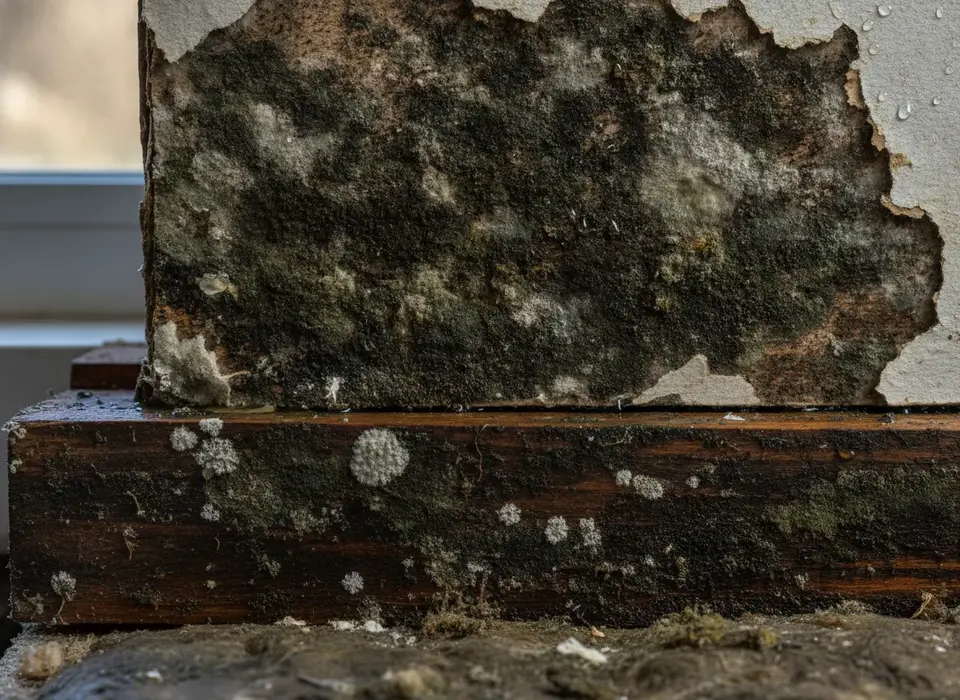
Is it too late to stop mold?
It is rarely too late to limit it. Mold that has started on materials you are removing anyway (wet drywall, insulation, carpet and pad) leaves with those materials. The goal after the first two days shifts from preventing mold to containing it: get the wet porous materials out, dry the framing and subfloor to a measured target, and clean what stays.
What makes it worse is waiting with the house closed up, or painting and rebuilding over framing that never fully dried. That is how a flood turns into a mold problem a year later.
What to keep, clean or throw out
EPA's post-disaster guidance generally treats porous materials soaked by floodwater as items to discard, and hard, non-porous surfaces as items to clean and dry. A quick guide:
| Material | After floodwater, generally | Notes |
|---|---|---|
| Drywall and wall insulation | Remove above the water line | Ask about asbestos testing first in older homes (see below) |
| Carpet and pad | Discard | Floodwater carries contaminants that cleaning does not reliably remove |
| Upholstered furniture, mattresses | Usually discard | Photograph and list them first for insurance |
| Wood framing and subfloor | Clean, dry and verify with a moisture meter | Replace only if structurally damaged or it will not dry |
| Concrete, tile, metal, glass | Clean and dry | Remove mud and silt, then clean the surface |
| Food from a flooded fridge or freezer | Discard | ACPHD guidance |
Before anything goes to the curb, take photos and video of each room and item. Documentation helps with insurance and with damage reporting, though the Town of Pagosa Springs notes that documenting damage does not guarantee eligibility for any program.
How to slow mold while you wait for help
- Wait until officials say the building is safe to enter, and wear boots, gloves and eye protection. EPA and CDC also recommend an N95 respirator when you are around mold.
- Open windows and doors when the outside air is drier than the inside air, and keep air moving.
- Shovel out mud and silt. Mud holds water against walls and floors.
- Pull wet carpet, pad and soaked contents out of the house, after photographing them.
- Do not run the furnace or central air if the ducts or air handler took on floodwater until they are checked.
- Do not mix bleach with ammonia or other cleaners, and do not paint over mold.
Free volunteer help may be available. Crisis Cleanup handles muck-out, debris and mold work for people who request it at 970-283-7325, through Nov 6, 2026 per the Town; check current status, since demand is high and help is not guaranteed. Call 211 for shelter, food and other needs.
When to call a restoration company
The EPA's general rule of thumb is that a homeowner can often handle a mold area of about 10 square feet or less. Flooded homes are usually far past that. Consider professional help when:
- More than one room, or any wall cavity, took on floodwater.
- The crawl space, basement or ductwork flooded.
- Anyone in the home has asthma, a weakened immune system or breathing symptoms. See a doctor about symptoms.
- You need moisture readings and a drying log for an insurer.
The independent companies we connect you with typically remove wet materials, set up containment, run air movers and dehumidifiers, clean and treat framing, and log moisture readings until the structure is dry. Read more on mold after flooding and structural drying.
What mold cleanup typically costs
National published figures put mold remediation at about $1,200 to $3,750, with an average near $2,300 (This Old House, 2025 to 2026). Large flood losses with tear-out often run past that, and every job is different. These are typical national ranges, not local quotes; Pagosa Springs quotes come from the companies. See the water damage restoration cost guide for the full table.
Colorado notes before you hire
- No state mold license. Colorado has no state license for mold remediation or water damage restoration. Ask about IICRC training as an optional extra, a certificate of insurance, and a written, itemized estimate.
- Town business license. Inside Town of Pagosa Springs limits, contractors and all their subcontractors need a Town business license. Unincorporated Archuleta County has no business license.
- Asbestos question first. Flood-damaged drywall in older homes may contain asbestos in joint compound or tape, according to the Town. Ask about testing before tear-out. See asbestos and flood-damaged drywall.
- Floodplain permit. Archuleta County requires a Floodplain Development Permit before any work in the floodway or floodplain. Inside Town limits, contact the Town Building Division.
For the bigger picture on safety, free help, insurance and debris rules, see the Pagosa Springs flood 2026 recovery guide. When you are ready, describe the damage once and independent companies can reply with quotes.
Frequently asked questions
How long does it take for mold to grow after a flood?
The EPA says that if wet materials are dried within 24 to 48 hours, in most cases mold will not grow. After a flood, the EPA advises that if you could not dry your home within 24 to 48 hours, you should assume mold is growing and plan the cleanup with that in mind.
Can I just bleach the walls after a flood?
Bleach on the face of drywall does not reach mold on the back of the panel or inside the wall cavity. Soaked drywall and insulation are generally removed above the water line. Never mix bleach with ammonia or other cleaners, and do not paint over mold.
Does cold weather stop mold after flooding?
Cold slows mold growth but does not dry anything. A closed, unheated house with wet walls can stay damp for weeks, and growth picks up when the heat comes back on. Drying the structure to a measured target is what actually prevents it.
Is mold remediation licensed in Colorado?
Colorado has no state license for mold remediation. Ask a company for a certificate of insurance, a written itemized estimate, and a Town of Pagosa Springs business license if the work is inside Town limits. IICRC training is a useful optional extra.