
Asbestos and Flood-Damaged Drywall: What to Ask Before Tear-Out
After a flood, the first instinct is to start ripping out wet drywall. In an older home, it is worth pausing for one question first: could this material contain asbestos? The Town of Pagosa Springs and Archuleta County both warn that drywall in older homes may contain asbestos in the joint compound or tape. Colorado also applies its asbestos rules to single-family homes, which is stricter than the federal baseline.
This guide explains the Colorado rules in plain terms, why a flooded room can cross the thresholds quickly, and what to ask a restoration company before tear-out begins. It is not legal advice; the Colorado Department of Public Health and Environment (CDPHE) has the official rules.
Safety first, as of November 1, 2026. A second San Juan River crest is forecast for the night of November 1 (the National Weather Service forecast 22.0 ft; Archuleta County, via the Town, forecast about 19.71 ft). Forecasts are forecasts and can change. If you are under an evacuation order, leave and come back to this later. Do not go into a flooded building until officials say it is safe, and turn off power only if you can do it safely.
Why drywall can contain asbestos
Asbestos was added to some joint compounds, tapes and wall and ceiling textures for decades. It is most commonly associated with older homes, especially those built before the 1980s, though age alone does not tell you either way. When the material is intact, it is generally not a concern. Cutting, breaking and sanding are what release fibers, and flood tear-out does all three.
Housing age in the area varies. Census survey data (2020 to 2024) puts the median year built at 1984 in the Town of Pagosa Springs and 1996 countywide, so plenty of homes predate the 1980s, especially in and around the older parts of town.
Colorado Regulation 8 in plain terms
Colorado's asbestos rules (CDPHE Regulation 8, Part B) apply to single-family homes, not just commercial buildings. In general terms:
| Item | Single-family home trigger |
|---|---|
| Other surfaces (such as drywall, joint compound, textures) | 32 square feet |
| Pipes | 50 linear feet |
| Volume | The volume of a 55-gallon drum |
Disturbing more than these amounts of asbestos-containing material generally triggers inspection by a CDPHE-certified inspector beforehand, and abatement by certified workers with notice to the state. Check the exact requirements with CDPHE for your situation.
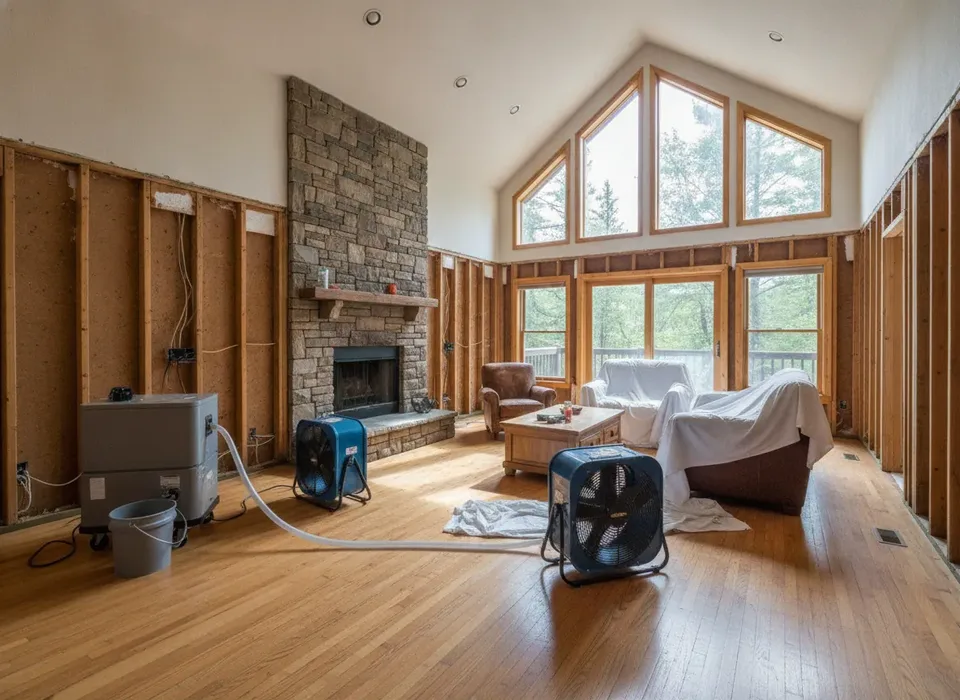
The math after a flood. A 12 by 14 foot room cut two feet up the walls removes about 104 square feet of drywall. That is more than three times the 32 square foot trigger, from one room. Testing first is not overcaution; for older homes it is often the starting point.
Testing and drying at the same time
Floods create a real tension. EPA guidance says to dry wet materials within 24 to 48 hours, or assume mold will grow. Asbestos testing takes some time. You do not have to choose one or the other entirely. Ask companies:
- Can a certified inspector take samples right away, and how long will results take?
- What can be done to dry the space meanwhile without disturbing suspect material, such as removing standing water, mud, carpet and contents, and running dehumidifiers?
- If results are positive, who does the abatement, and who files any required notice?
- Will the drywall be separated and bagged in a way the landfill will accept?
The Archuleta County Landfill accepts flood-damaged drywall only when separated before arrival, and the County notes that disposal fees are the responsibility of the individual. The Town and County wood-only debris sites do not take drywall.
Lead paint in pre-1978 homes
Homes built before 1978 may have lead-based paint on walls, trim and doors. Firms that disturb painted surfaces in pre-1978 homes for pay generally need EPA Lead-Safe (RRP) certification and must follow lead-safe work practices. Ask whether the company holds that certification if your home is that old, and see the EPA's Lead-Safe resources for details.
Questions to ask before tear-out
- Was the home built before the 1980s, and do you recommend asbestos testing before cutting drywall?
- Who will take the samples, and is that inspector CDPHE-certified?
- Is asbestos testing or abatement included in your estimate, or separate?
- If the home is pre-1978, are you EPA Lead-Safe certified?
- Is the property in the floodplain, and has the Archuleta County Floodplain Development Permit been obtained? Inside Town limits, have you contacted the Town Building Division?
- Do you and your subcontractors hold a Town of Pagosa Springs business license, if the work is inside Town limits?
- Can I have a written, itemized estimate and a certificate of insurance?
Colorado has no state license for water damage restoration, so these questions do the work a license check would do elsewhere. More on hiring safely: avoiding contractor scams after a Colorado flood.
What about volunteers and DIY?
Many people are clearing their own homes, and free volunteer help exists. Crisis Cleanup volunteers help with muck-out, debris and mold at 970-283-7325, through Nov 6, 2026 per the Town; check current status, since help is not guaranteed. Call 211 for other needs. Whoever does the work, the same question applies to older drywall: ask about asbestos before cutting. Mud, wet carpet and contents can usually come out first without touching the walls.
Wear boots, gloves and eye protection around floodwater, which can carry sewage, and see a doctor about any symptoms.
Cost and insurance notes
Asbestos testing and abatement are not included in the typical flood cleanup ranges on this site, so ask for them as separate line items. The water damage restoration cost guide lists what the published ranges cover. On insurance, standard homeowners policies generally exclude flood; NFIP policyholders should file a signed proof of loss within 60 days unless FEMA extends it, and keep testing reports with their claim records.
For safety, free help, debris rules and assistance status, see the Pagosa Springs flood 2026 recovery guide. For tear-out and drying, read flood cleanup and water extraction, then request free quotes. Mention the year your home was built so companies can plan for testing.
Frequently asked questions
Does flood-damaged drywall contain asbestos?
It can, in older homes. The Town of Pagosa Springs and Archuleta County warn that drywall in older homes may contain asbestos in joint compound or tape. The only way to know is to have samples tested before the material is cut or removed.
Do Colorado asbestos rules apply to single-family homes?
Yes. Colorado's Regulation 8 applies to single-family homes. Disturbing more than about 32 square feet of other surfaces, 50 linear feet of pipe, or a 55-gallon drum's volume of asbestos-containing material generally triggers inspection and certified abatement. Check details with CDPHE.
Can I remove flooded drywall myself?
In an older home, ask about asbestos testing first, because a typical flood cut in one room easily exceeds Colorado's 32 square foot threshold. You can usually remove mud, wet carpet and contents first without disturbing walls. Wear boots, gloves and eye protection around floodwater.
Where does flood-damaged drywall go in Archuleta County?
The Archuleta County Landfill at 9179 CR 500 accepts flood-damaged drywall that is separated before arrival, and disposal fees are the responsibility of the individual. The Town and County wood-only debris sites do not accept drywall.